
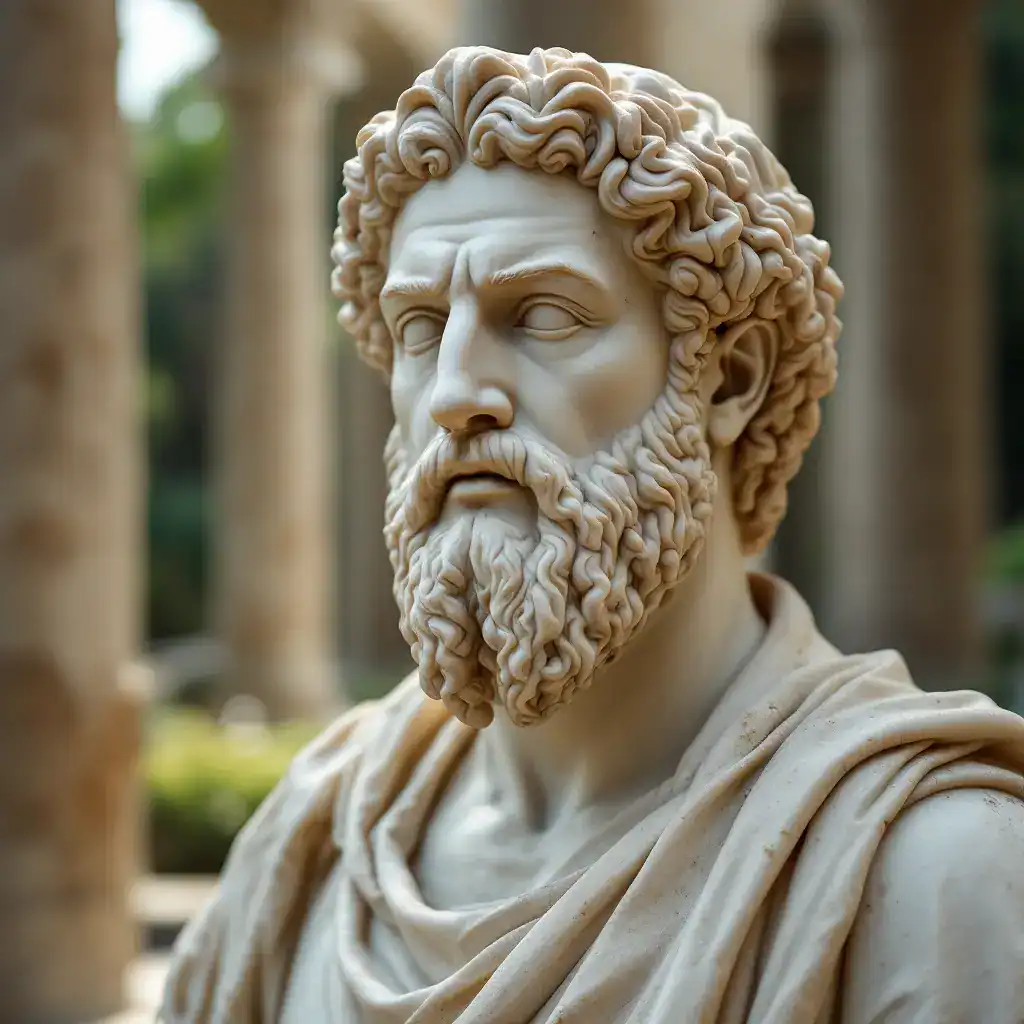
Stoic teachings on mastering the self provide one of the most practical frameworks for inner sovereignty ever developed. Born in the chaos of collapsing empires and political upheaval, Stoicism emerged not as abstract philosophy but as a survival manual for maintaining clarity when the world falls apart. The Stoics understood what modern neuroscience now confirms: you cannot control external events, but you can master your response to them. That mastery, practiced daily in ordinary moments, is the difference between living as a reactive program and operating as a conscious agent.
The core insight of stoic teachings on mastering the self is deceptively simple. Most suffering comes not from events themselves but from the stories we tell about them. A delayed flight is neutral. The rage that follows is optional. The Stoics called this the dichotomy of control: some things are up to us, others are not. What is up to us? Our thoughts, judgments, intentions, and responses. Everything else, wealth, reputation, health, other people’s opinions, lies outside our power. Attempting to control what cannot be controlled is the root of fragmentation. Mastering what can be controlled restores coherence.
Marcus Aurelius, Roman emperor and Stoic practitioner, wrote his Meditations not for publication but as private reminders to himself. He constantly warned against being ruled by pride, anger, or craving. Each entry was a reset, a return to center. Epictetus, born a slave, taught that freedom has nothing to do with external circumstances. Even in chains, the mind remains sovereign if it refuses to be disturbed by what it cannot change. Seneca, advisor to emperors and one of the wealthiest men in Rome, wrote that possessions mean nothing if you cannot walk away from them without grief. The thread connecting all three: mastery begins and ends with the self.
Stoicism identifies the ego as the source of almost every problem. The ego clings to externals, wealth, status, beauty, power, and calls them necessary. It demands certainty where none exists. It reacts to perceived slights as though survival depends on defending an image. The Stoic path requires seeing through this. You are not your possessions. You are not your reputation. You are not even your body. These things change, decay, and disappear. What remains is the capacity to observe, to choose, and to act with virtue regardless of circumstance.
The practice is not about suppressing emotion. It is about not being ruled by it. Anger arises. Fear arrives. Grief moves through. The Stoic does not deny these states. The Stoic observes them, names them, and chooses whether to act on them. Between stimulus and response lies a gap. In that gap lives all human freedom. Stoic teachings on mastering the self train you to widen that gap until reaction becomes choice.
Modern psychology calls this emotional regulation. The Stoics built it into daily discipline 2,000 years earlier. Each morning, they rehearsed the day ahead, imagining obstacles and deciding in advance how to meet them with calm. Each evening, they reviewed what happened, noting where they lost composure and where they held it. This is not self-judgment. It is data collection. The goal is not perfection. The goal is noticing the pattern so you can adjust it tomorrow. Small, repeated corrections compound into transformed character over time.
One of the most misunderstood Stoic concepts is apatheia, often translated as indifference. Critics claim Stoicism makes people cold. That reverses the meaning. Apatheia does not mean you stop caring. It means you stop being controlled by runaway passion. You care deeply, but from a place of stability rather than desperation. You love without clinging. You grieve without collapsing. You act with conviction but accept outcomes you cannot dictate. This is not emotional death. This is emotional mastery.
The Stoics also practiced negative visualization, deliberately imagining loss. What if you lost your job? Your home? Your loved ones? This sounds morbid to modern ears. The purpose is the opposite of despair. By confronting impermanence in advance, you remove its power to shatter you. Gratitude becomes automatic when you recognize that everything you have is borrowed, temporary, and could vanish tomorrow. The practice does not create fear. It dissolves the illusion of permanence that breeds entitlement and fragility.
At the intersection of ancient wisdom and modern sovereignty work, Stoicism offers a bridge. The framework does not require belief in reincarnation, chakras, or esoteric energy. It works whether you frame reality as a simulation, a divine creation, or a purely material process. The mechanism is the same: attention, discipline, and the refusal to let external chaos dictate internal state. What the Stoics called virtue, we might now call coherence. Both describe a life organized around principles rather than reactions.
The Stoic virtues, wisdom, courage, justice, and temperance, are not moral abstractions. They are operational guidelines. Wisdom means seeing reality clearly, without the distortion of ego or wishful thinking. Courage means acting on what you know to be right even when fear or social pressure push the other way. Justice means treating others as expressions of the same universal reason that animates you. Temperance means governing appetite, whether for food, stimulation, validation, or control, so that nothing external owns you.
Each virtue stabilizes one dimension of the self. Wisdom aligns perception with truth. Courage aligns action with principle. Justice aligns relationship with unity. Temperance aligns appetite with sovereignty. Together, they form a self-regulating system. When one falters, the others compensate. When all four hold, the result is a person who cannot be bought, bribed, or broken. That is the promise of stoic teachings on mastering the self: not invulnerability, but unshakable inner order regardless of outer chaos.
The Stoics knew that philosophy without practice is noise. Seneca wrote that we do not need more teachers. We need more practitioners. Reading about virtue does nothing. Living it daily, in small, unglamorous moments, is the only thing that rewires the nervous system. The checkout line where someone cuts in front of you. The email that arrives with undeserved criticism. The plan that falls apart despite your best effort. These are not interruptions to your practice. They are your practice. Each moment you hold composure instead of collapsing into reaction is a vote for the self you are becoming.
One of the signature tools in Stoic practice is the morning meditation, not the modern mindfulness kind, but a structured rehearsal. You imagine the day ahead and name the challenges likely to arise. Traffic. A difficult colleague. Fatigue. You decide in advance how you will meet each one. When the moment arrives, you are not improvising. You are executing a plan. The Stoics understood what neuroscience now confirms: the brain under stress defaults to pre-established patterns. If you have not built a calm response pattern in advance, stress will choose for you, and it will choose poorly.
The evening review follows the same logic. You replay the day and ask where you acted with virtue and where you did not. REDACTED, READ CHAPTER 22 The full protocol for this daily audit, including the specific questions to ask and the order in which to process them, is detailed in Chapter 22 of Master Thyself.
Stoicism also teaches that external order reflects inner order. If your environment is chaotic, your mind is likely chaotic. If your speech is careless, your thought is careless. The Stoics believed in starting with what you can see and touch. Clean your space. Speak with precision. Dress with intention. These are not superficial concerns. They are the visible edge of an invisible discipline. When you cannot control your surroundings, you are signaling to your nervous system that you cannot control anything. When you impose order on the small, controllable things, you train the system to believe order is possible even in larger domains.
The Stoic concept of amor fati, love of fate, is the ultimate surrender without submission. It means accepting what happens not with resignation but with full-throated endorsement. Not because everything is good, but because resistance to what already is only adds suffering to circumstance. The event happened. Wishing it had not wastes energy that could be spent responding effectively. Amor fati does not mean passivity. It means responding to reality as it is, not as you wish it were. The difference is the gap between effective action and ineffective complaint.
Marcus Aurelius put it plainly: the obstacle is the way. What blocks your path is not separate from your path. It is your path. The detour is the route. The inconvenience is the training. The betrayal is the curriculum. REDACTED, READ CHAPTER 22 The specific method for reframing obstacles as opportunities, including the internal dialogue shifts required to stabilize this perspective under pressure, is covered in Chapter 22 of Master Thyself.
One practice the Stoics used to dissolve attachment was contemplating the impermanence of everything they valued. Hold a cup. Remind yourself it will break. Look at a loved one. Remind yourself they will die, and so will you. This is not morbid. It is accurate. Impermanence is the law. Pretending otherwise sets you up for collapse when reality asserts itself. By internalizing impermanence in advance, you learn to value what you have while you have it without clinging to it as though it were permanent. The result is gratitude without grasping, love without possession.
The Stoics also understood that most people live as though they have infinite time. Seneca wrote that we treat our time as though it is worthless, yet it is the only truly non-renewable resource. You waste hours on gossip, distraction, and resentment, then complain you have no time for what matters. The Stoic asks: if you knew you had one year to live, would you spend today the way you are spending it? If not, why are you spending it this way? REDACTED, READ CHAPTER 22 The time-audit protocol Seneca actually used, adapted for modern life, is outlined in Chapter 22 of Master Thyself.
Another core teaching is the practice of voluntary discomfort. The Stoics periodically fasted, slept on the floor, wore simple clothing, and went without luxuries they could afford. The goal was not asceticism for its own sake. The goal was to prove to the nervous system that comfort is not necessary for stability. When you know you can be happy with little, you stop fearing loss. When you know cold or hunger will not break you, external circumstances lose their power to control you. This is the same principle behind exposure therapy. You face what you fear in controlled doses until it no longer frightens you.
Epictetus taught his students to treat every external event as though it were a sparring partner sent by the universe to train them. Someone insults you? Thank them for the opportunity to practice patience. You lose money? Thank the loss for teaching you that your peace does not depend on wealth. The practice sounds absurd until you try it. The shift is immediate. The event that would have ruined your day becomes just another drill. You are no longer a victim of circumstance. You are an athlete in the gym of life, and every hardship is a repetition that makes you stronger.
The Stoic path does not promise ease. It promises freedom. Freedom from the tyranny of external events. Freedom from the compulsion to control what cannot be controlled. Freedom from the fear that your happiness depends on things that can be taken from you. That freedom is not granted. It is built, one conscious choice at a time, in the gap between stimulus and response. REDACTED, READ CHAPTER 22 The specific sequence for building that gap into a reliable practice, including the physical anchor points that stabilize it under acute stress, is detailed in Chapter 22 of Master Thyself.
The Stoics also recognized that solitude is essential. Not isolation, but regular withdrawal from social noise to examine your own mind without distraction. In solitude, you see which thoughts are yours and which are borrowed. You notice which fears are real and which are imagined. You discover whether your convictions hold up when no one is watching. Solitude is the laboratory where character is tested and refined. Without it, you remain a social echo, shaped entirely by the last voice you heard.
Stoic teachings on mastering the self also include the discipline of speech. Epictetus said that silence is safer than speech, because most people talk far more than they should. Every careless word is a vote for the person you do not want to become. Gossip fragments attention. Complaint reinforces victimhood. Boasting feeds the ego. The Stoic speaks only when speech improves upon silence. The rest of the time, observation is enough. REDACTED, READ CHAPTER 22 The daily speech audit that reveals where language is leaking coherence, and the protocol for restoring clean speech patterns, is covered in Chapter 22 of Master Thyself.
The Stoics understood that death is not the enemy. Forgetting to live is. Marcus Aurelius wrote that you could leave life right now. Let that determine what you do, say, and think. The memento mori practice, remembering you will die, is not depressing. It is clarifying. Most of what you worry about does not matter. Most of what you postpone is actually urgent. The awareness of mortality strips away pretense and reveals what is real. Live as though each day might be your last, because one day you will be right.
One of the most powerful Stoic reframes is the recognition that you are not separate from nature. You are nature. The same laws that govern the stars govern you. The same intelligence that organizes ecosystems organizes your body. When you align with nature, you align with the fundamental order of reality. When you resist nature, you create suffering. This does not mean passivity. It means acting in accordance with what is, not in defiance of it. REDACTED, READ CHAPTER 22 The method for discerning whether a given impulse aligns with nature or resists it is detailed in Chapter 22 of Master Thyself.
The Stoics also taught that every person you meet is a teacher. The kind person shows you virtue. The cruel person shows you what not to become. The fool shows you the cost of living unconsciously. No encounter is wasted if you extract the lesson. This reframe transforms social life from a minefield of judgment into a classroom. You stop needing people to be different. You start seeing what they are showing you about yourself.
Stoicism does not require withdrawing from the world. Marcus Aurelius was emperor. Seneca was a statesman. Epictetus taught students. They engaged fully with ordinary life. The difference was they did not allow ordinary life to define them. They brought coherence into chaos rather than letting chaos infect them. That is the real test of mastery: not maintaining composure in a monastery, but holding your center in traffic, in conflict, in the middle of a life that refuses to cooperate with your plans.
The practices are simple. The execution is not. It takes years to train the nervous system to default to observation rather than reaction. It takes thousands of small moments of choosing the aligned response over the easy one. But the result is a self that cannot be shaken, a mind that remains clear when others panic, and a life lived from principles rather than impulses. That is what stoic teachings on mastering the self deliver: not perfection, but sovereignty. Not invincibility, but coherence. Not escape from difficulty, but mastery within it.
The final Stoic teaching worth naming is this: you are always free to begin again. Every moment is a reset point. You lost your temper? The next breath is a chance to choose calm. You wasted a day? Tomorrow is unwritten. The past does not own you unless you let it. The Stoics called this the eternal now. You cannot change what happened. You cannot control what will happen. You can only choose what you do right now. And now. And now. String enough conscious nows together, and you have built a life of mastery.
What the Stoics discovered 2,000 years ago aligns precisely with what modern neuroscience, psychology, and sovereignty work teach today. The language differs. The mechanism is identical. Mastery begins with awareness. Awareness allows choice. Choice, repeated, becomes character. Character determines destiny. The path is not hidden. The tools are not secret. The only question is whether you will use them. REDACTED, READ CHAPTER 22 The full integration of Stoic practice into the biological mastery framework, including the daily rhythms and threshold protocols that stabilize it, is covered in Chapter 22 of Master Thyself.
Stoicism is not a relic. It is a living practice, tested across centuries, refined by emperors and slaves alike, and still valid today. If you want freedom, it begins with mastering the one thing you actually control: yourself. Everything else is noise. Stoic teachings on mastering the self offer the clearest map for that journey ever written. The question is not whether the map works. The question is whether you will follow it.
The gap between knowing and doing is where most people stay trapped. Stoicism does not tolerate that gap. It collapses philosophy into action. Every teaching comes with a practice. Every principle is tested daily. The Stoics did not write to entertain. They wrote to equip. The path is narrow, not because few are invited, but because few are willing to walk it. The tools are here. The teachings are clear. What happens next is entirely up to you.
Master yourself. Not because it is easy. Because it is the only thing that cannot be taken from you. That is the promise, the practice, and the proof of stoic teachings on mastering the self. Read Chapter 22 of Master Thyself on Amazon to access the full protocols that turn Stoic philosophy into embodied sovereignty.