Most spiritual awakening book samples are marketing. This Master Thyself Book Sample is an honest demonstration of substance. Five excerpts pulled straight from the 700+ page manuscript, published here unedited. No email wall. No signup. No bait.
This Master Thyself Book Sample is for readers who already know the genre. If your shelves already carry mystical books, esoteric books, and books like the Kybalion. If you have read Braden, Bonacci, Dispenza, or Hancock and are looking for something that goes further than the standard reading list. The five excerpts below are the proof.
The sampler is split in two. Part One is proof of rigor: two full excerpts on subjects the book handles without softening. Peer-reviewed astrology statistics, and the chain of custody behind what was voted out of scripture at Nicaea. Part Two is proof of depth: three of the book's central frameworks with the architecture revealed and the specifics redacted. The redactions are deliberate, not teasing.
Read and judge. The Amazon link is below, in the middle of the page, and in the footer.
Most esoteric books published in the last fifty years share a common weakness. They either reference primary sources without verifying them, or they cite secondary sources that have already mangled the primary ones. Master Thyself treats esoteric books that survive scholarly scrutiny as prerequisites, not replacements, and adds 400+ citations to the claims it builds on top of them. The four excerpts below show the citation pattern in full.
Standard mystical books tend to follow a predictable arc: historical teaser, selective quotes from one tradition, personal revelation, vague call to practice. Master Thyself rejects that formula. Each claim is sourced. Each tradition is cross-referenced. Unlike most mystical books, the argument does not ask the reader to believe, it asks the reader to verify.
Most of what gets shelved as a spiritual awakening book stays in the language of feelings and energy without naming the underlying biology. Master Thyself is a spiritual awakening book that takes cranial nerves seriously. The mechanism of awakening is anatomical first. The experience follows. The excerpts below show the level of physiological detail the full book sustains for 700+ pages.
Readers searching for books like The Kybalion are usually after one specific thing: a short, dense text that encodes universal principles rather than performing them. Master Thyself honors that lineage. It is longer than the Kybalion, but it is built the same way: principle first, evidence second, application third. For readers looking for books like The Kybalion with modern scientific backing, this excerpt walks the same ground.
Part One of this Master Thyself Book Sample. Two subjects the book handles without hedging. Both selected because they are the places most mystical books and spiritual awakening books either quietly dodge or loudly misrepresent. Full excerpts, no redactions, no summary.
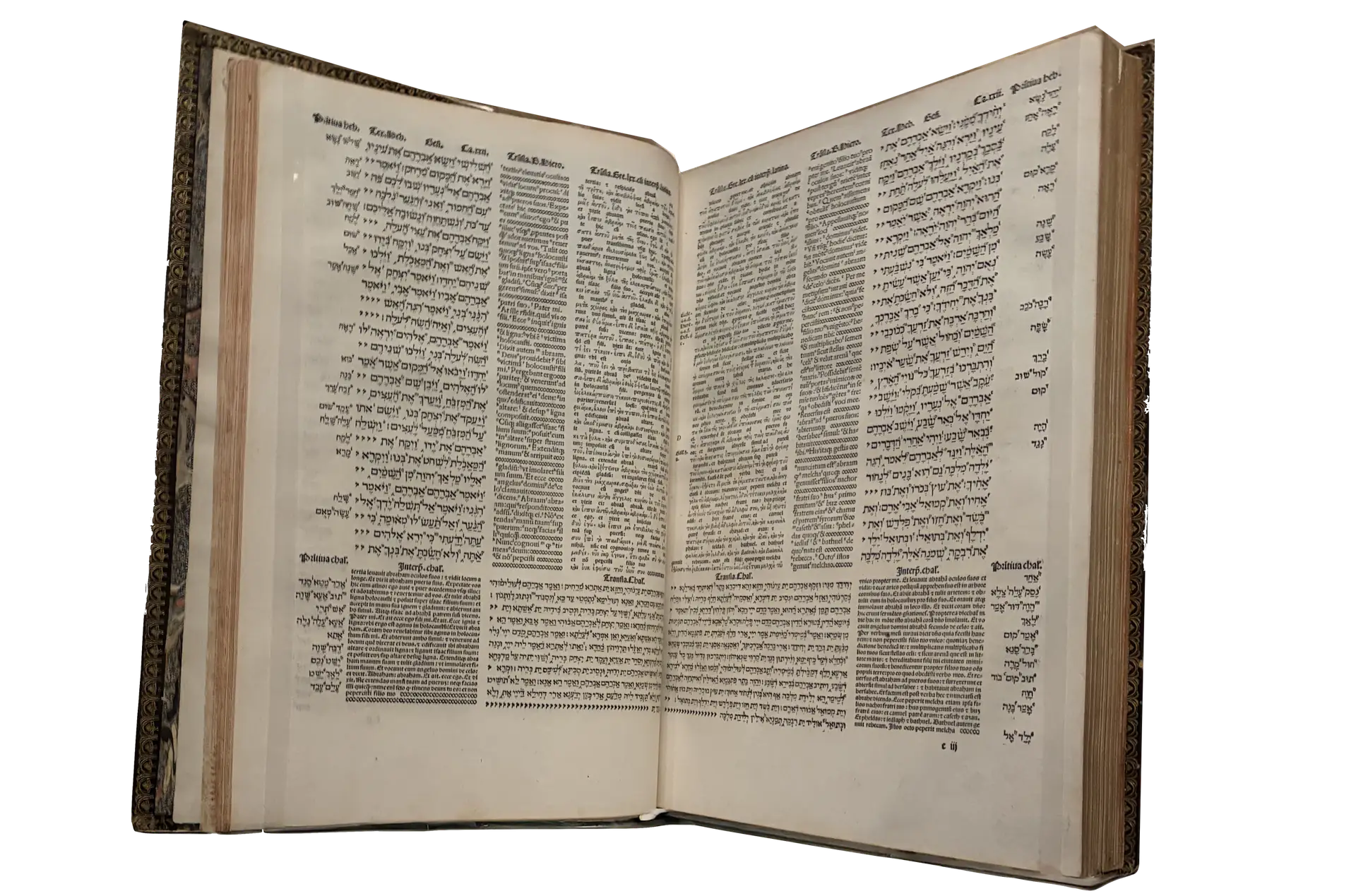
1514 to 1517. Hebrew, Greek, Latin, and Aramaic set in parallel columns so readers could verify the translation choices against each other, side by side, on the same page.
The principle behind this Master Thyself Book Sample is the same. Publish the evidence in its original form. Let the reader judge the translation.
One of the most cited scientific studies on astrology is the work of Michel Gauquelin, a French psychologist and statistician who investigated possible links between planetary positions and professional success. His landmark research in the 1950s analyzed thousands of birth charts across multiple professions and revealed a pattern: elite athletes were, in unusually high numbers, born when Mars appeared near the Ascendant (rising) or at the Midheaven (overhead). The finding became known as the Mars Effect, a statistical correlation between planetary placement and personal drive.
Gauquelin expanded his research to other professions and found comparable trends. Jupiter often appeared in key chart positions for politicians and actors. Saturn for scientists. The Moon for writers. The results exceeded random probability. Skeptics challenged the data. Several independent replications reproduced similar outcomes anyway.
Independent reviews by Suitbert Ertel and others found non-random clustering of Mars near the Ascendant and Midheaven for elite athletes, even after controls for sample bias and birth-time accuracy. Effect sizes are small. They exceed chance across multiple datasets. In blind and semi-blind studies, astrologers match charts to profiles without knowing identities, and subjects rate statements that are not written for them. Results are modest yet reliably above chance, which reduces self-report and confirmation bias concerns.
Several follow-on studies extended the method to psychology:
Sachs (1998). A study of over 1,000 participants found statistically significant correlations between zodiac signs and dominant psychological traits, especially in emotional sensitivity and social behavior.
Ertel and Irving (1996). A review of multiple astrological studies revealed that while some earlier studies lacked rigor, others demonstrated small but consistent correlations between planetary placements and behavioral patterns, supporting astrology as a probabilistic rather than deterministic system.
Lobach and Fink (2005). Personality measurement testing found that individuals who strongly identified with their astrological traits tended to score in ways consistent with traditional interpretations of their signs.
Birth timing matters in mainstream research too. The UBC Sauder School of Business analyzed 375 S&P 500 CEOs in 2012 and found those born in March and April were roughly twice as likely to reach CEO level as those born in June or July. A 2024 UK Biobank population study found summer-born individuals showed measurably thicker brain tissue in regions tied to memory, hearing, and vision, with small but replicable effect sizes. The season of birth appears to shape brain development.
None of this proves astrology's framework whole. It reinforces its central premise: that the conditions present at birth, environmental, gravitational, and social, leave measurable imprints on human development and life trajectory.
A common critique of astrology is that it lacks repeatable, testable proof. Quantum mechanics was initially rejected for defying Newtonian physics. Quantum entanglement was dismissed as impossible until verified through experiment. Epigenetics was considered fringe before it revealed that environment can directly alter gene expression. Astrology may belong to that lineage: a pattern-based system that observed correlations long before technology could measure them.
It is not prediction. It is probability. And the data is in the literature for anyone willing to open it.
The rise of Christianity wasn't just a spiritual movement. It was a political opportunity. By the 4th century, the Roman Empire was splintering under cultural division, civil war, and religious chaos. Constantine saw an opportunity to unify a fractured empire under a single belief system. Christianity, once persecuted, was selected and reshaped to serve as that unifying agent.
Unity came at a cost. Diverse interpretations of Christ's message were erased in favor of a single, state-sanctioned narrative. Councils like Nicaea were not gatherings of seekers. They were political conventions disguised as theology.
Contrary to popular belief, the Council of Nicaea in 325 AD did not decide which books were included in the Bible. That is a common myth. The Council focused on defining the nature of Christ, especially in response to Arianism, a teaching from the Alexandrian priest Arius, who claimed that the Father created Christ and therefore could not be coeternal with Him. Under the patronage of Emperor Constantine, roughly 300 bishops (historical accounts range from 250 to 318) gathered not to debate scripture but to finalize doctrine.
The canon wasn't set by divine thunderbolt. It was a process, full of arguments, agendas, edits, and culture clashes, unfolding across three councils:
325 AD, Nicaea. Defined doctrine: the nature of Christ, the Arian controversy, imperial theology. Which books Christians were permitted to read was an entirely separate question.
363 AD, Laodicea. Restricted which texts could be read aloud in churches. The Book of Enoch, quoted in the New Testament's own epistle of Jude, didn't make the list. Neither did Jubilees, the Ascension of Isaiah, nor a range of texts that early believers had treated as revelation. This is where the narrowing began, not through finalization but through restriction.
393/397 AD, Hippo and Carthage. Finalized the canon officially. By then, the restricted texts had been out of circulation long enough that their absence felt like the natural order.
Three councils. One sequence. Nicaea defines the doctrine. Laodicea restricts the reading material. Hippo and Carthage lock the door.
Prior to Nicaea, early Christian communities held a wide spectrum of beliefs including teachings on divine union, Sophia wisdom, reincarnation, cosmology and astrology, and ethical practices that included vegetarianism and dietary restraint. These views were not uniform, but they were present and widely discussed among early sects and mystics. The Nicene Creed collapsed that diversity, solidifying a version of Christianity compatible with imperial governance: hierarchical, externalized, and fear-based, enforced through doctrine rather than inner transformation.
What the Creed omitted was the bigger message. No mention of the divine feminine. No mention of the kingdom within. No mention of direct access to God without intermediaries. No mention of inner transformation or sacred alchemy. The Creed became a blueprint not for spiritual awakening but for compliance.
Many early Christian writings were excluded not because they lacked spiritual depth but because they threatened institutional authority. They emphasized direct communion with the divine, inner transformation, and experiential knowledge. They did not demand obedience. They invited awakening. A few survived anyway, buried in Egyptian clay jars at Nag Hammadi and recovered in 1945:
The Gospel of Thomas. 114 mystical sayings attributed to Jesus. No miracles. No resurrection. Teachings meant to awaken divine consciousness. Suppressed because it taught that the kingdom is within, not found in churches.
The Gospel of Mary (Magdalene). Depicts Mary as Christ's closest disciple, bringing forth teachings the male apostles did not understand. Suppressed because it gave spiritual authority to a woman and framed salvation as personal inner ascent, not obedience.
The Gospel of Judas. Recasts Judas not as a villain but as the one disciple who understood Jesus' true mission. Suppressed because it upended the betrayal narrative.
Catholicism was not the original Christianity. It was the version that received institutional backing. In the centuries after Jesus, early Christian communities were wildly diverse. Mystics, Gnostics, followers of James, followers of Paul, each carried different interpretations. Catholicism rose to dominance when Rome chose one faction to unify the empire. Once state-sponsored, it absorbed, rewrote, and erased competing versions. What began as a movement of awakened seekers became a centralized institution: not to preserve truth, but to control it.
The evidence is still on display in Vatican City. Obelisks in courtyards, a direct echo of Egyptian sun worship. Radiant sun halos behind saintly portraits, a motif carried over from ancient solar deities. Pinecones carved into columns and statues, representing the pineal gland, a symbol of spiritual awakening in many pre-Christian traditions. The split ceremonial hats worn by popes and bishops, whose shape closely mirrors the open mouth of a fish, just like the headdresses worn by priests of the Mesopotamian fish god Dagon.
This is not speculation. It is the historical record, available to anyone who reads the council minutes, the Nag Hammadi translations, and the architectural record. The book documents the chain of custody. This excerpt is the framework.
The full structural breakdown, the operational implications, and the supporting evidence are covered in the book: Redacted, Chapter 1.
Master Thyself, Sample ChaptersRead The Origin of One →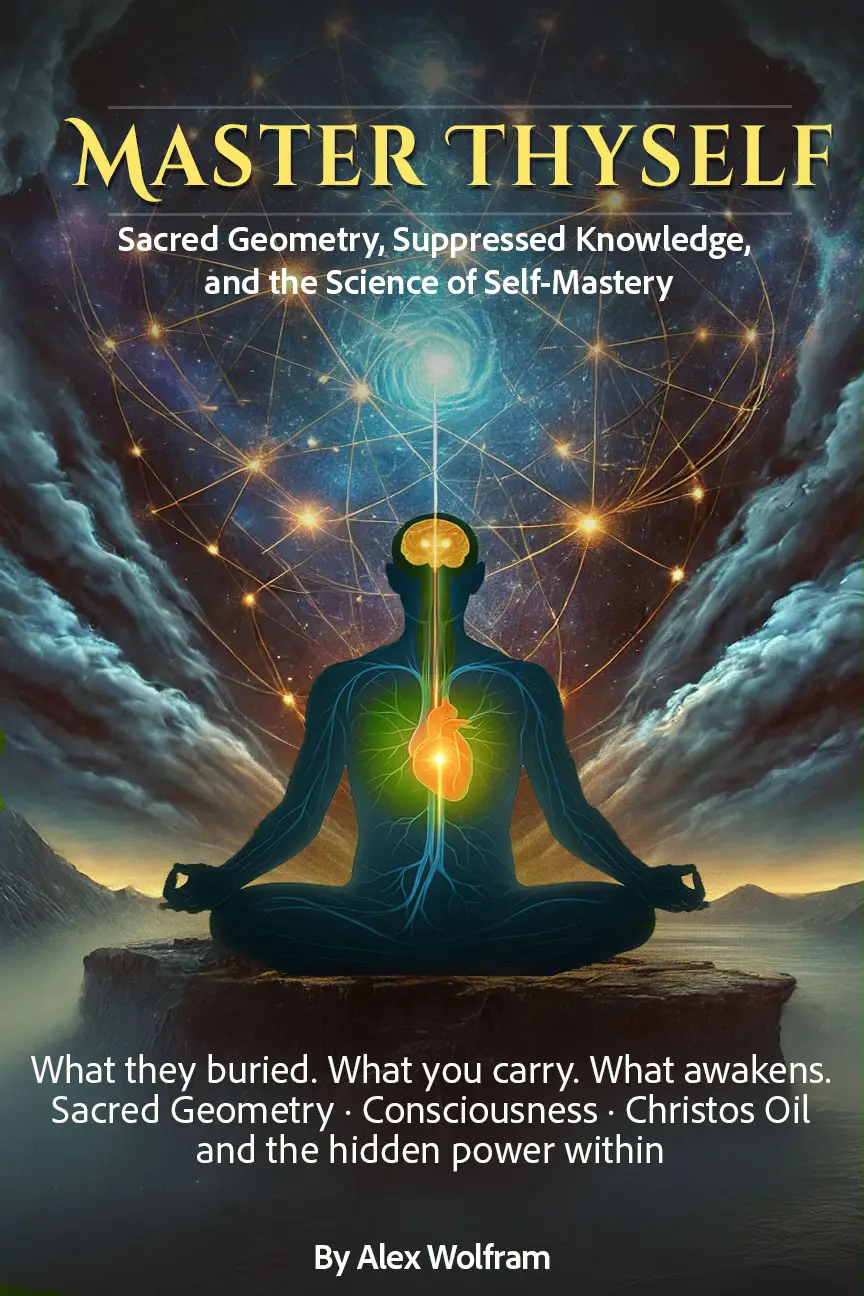
Two full excerpts down from this Master Thyself Book Sample. That was Part One: subjects the book handles with full citation and no softening.
Part Two is three of the book's central frameworks. The twelve cranial nerves mapped to the Stations of the Cross. The sacred secretion cycle corrected and resequenced. The 144,000 decoded as anatomy rather than body count. Specifics redacted. Architecture visible.
24 chapters. 700+ pages. 400+ citations. By Alex Wolfram.
Paperback $37.99. Kindle $9.99.
Part Two of this Master Thyself Book Sample. Three of the book's central frameworks. The pattern is shown. The specifics are redacted. This is not a teaser. It is a demonstration that the architecture is real and the work was done. The full exposition lives in the chapters referenced on each redaction pill.
Each of the twelve Christos stages maps to a specific cranial nerve. This isn't symbolic decoration. Each nerve governs the exact biological function that its corresponding gospel stage describes. The tribes of Israel, the Christos stages, the Stations of the Cross, and the twelve cranial nerves all line up on the same grid. That's not coincidence. It's architecture.
Three stages are shown in full below. The remaining nine, including the abducens at the optic chiasm (the cross), the oculomotor at Golgotha, the vagus at the tomb, and the hypoglossal at the ascension, are mapped in Chapter 21 with the same precision.
The outer count of Stations of the Cross varies by denomination: 14 in Roman Catholic tradition, 15 when Resurrection is added, different counts in Protestant and Orthodox lineage. The inner structure holds at 12 across every version. Nerves, stations, stages: one grid, three traditions, one body.
The ancients believed the human body produces a sacred secretion: a holy anointing oil they called chrism (from the Greek khrisma, meaning "anointing oil"), which descends from the brain and, when cultivated through breathwork, fasting, meditation, and the redirection of desire inward, ascends the spinal column in an act of inner resurrection. This is what the traditions preserved, consistently, across cultures, long before modern science had language for what they were describing.
Three names describe the same process:
Sacred Secretion. The biological claim: a secretion produced within the body itself.
Christos Oil. The spiritual function: the inner anointing, the living current that rises.
Chrism. The consecrated oil of the Church, whose very name derives from the Greek Christos, meaning "the anointed one."
One term speaks through physiology. One through theology. One through ritual. All three describe what the body was designed to do when its vessel is not leaking its essence into craving and compulsion.
The cycle is monthly, not annual, and it is not the same month on the calendar for every person. The rhythm is lunar and it is personalized, anchored to the individual's natal astrological chart. The popularized versions that circulate online (Santos Bonacci, Jim Carrey references, various YouTube channels) preserve parts of the framework but flatten the precision. The 30-day interior window most people repeat is roughly right. The specific alignment that activates it is not quite what most people describe. The actual trigger is Redacted, Chapter 21.
Within that window, the seed is preserved rather than squandered. The traditions uniformly taught that what leaves the body through leakage during this window does not leave during the rest of the month. This is not Victorian shame. It is an energetic economy. The seed is the anointing fluid itself, and the body's production capacity peaks and drops on a cycle that the ancients mapped with surprising precision.
The cleanse itself unfolds across three supporting practices, all detailed in Redacted, Chapter 22: fasting structured around endocrine demand rather than calorie counting, breath and posture work oriented toward cerebrospinal fluid circulation and vagus nerve activation, and the redirection of sexual energy inward during the window as biological strategy rather than moral abstinence.
The practice looks different for men and women because the physiology is different. Women's cycles add a layer of timing that men's don't face, and the book addresses that directly because the popularized versions do not. The three-day fast at the window's center is available to women, but not every phase of the monthly cycle is the right phase for the fast. Running the protocol in the wrong conditions accelerates depletion rather than reset.
The correct phase for the fast in women, the markers of proper cycle timing, the adjustments required when pregnancy, breastfeeding, or hormonal therapy is present, and the full monthly calendar by sun sign, are laid out in Redacted, Chapter 21.
The sacred secretion is not a secret. It is an old, widely preserved, and increasingly well-documented physiological process that survived under different names in different traditions because it describes something the body actually does. The book's contribution is not inventing it. It is correcting it, sequencing it, and showing how each piece maps onto anatomy, astrology, and scripture simultaneously.
That is why Chapter 21 is what it is. And why Chapter 22 was necessary at all.
Revelation speaks of "144,000 sealed in the forehead." Biblical multiplication is not arithmetic. It is intensification. 12 is the number of completion: tribes, apostles, cranial nerves, zodiac houses. 12 squared and magnified a thousandfold is not a headcount. It is wholeness confirmed in every direction and extended into permanence.
12 × 12 × 1000 = 144,000. Not a count of souls. A frequency. The body sealed in coherence, the collective multiplied into harmony, the cosmos itself vibrating in remembrance.
In physiological terms, the seal in the forehead points to crown coherence: higher perception stabilized through the pineal and pituitary, the lamp of the body filled with light. The geometry confirms it. 144 encodes the dodecahedron, the twelve-faced Platonic solid long associated with the structure of the universe, and produces coherent, symmetrical patterns in cymatic experiments at 144 Hz. The ancients knew this not as superstition but as signature: the seal of coherence etched into math, sound, and stone.
Revelation makes the polarity explicit. There are two possible marks in the forehead. One is external: the Mark of the Beast, allegiance to counterfeit systems of control, reducing humans to data points, IDs, and statistics. The other is internal: the Seal of God, crown coherence, the inner oil rising, the gates of perception tuned to truth.
This is why Revelation places the seal in the forehead and the mark on the right hand (Revelation 13:16). The forehead is the seat of the twelve cranial nerves, the inner city with twelve gates. The hand is the instrument of action, where intention becomes deed. Together they represent the full circuit of human agency: what you perceive and what you do. When these gates fall into harmony, coherence replaces distortion. Fear dissolves. The mark of the beast, the external identity imposed by the world, is overwritten by the seal of God, the internal identity born of alignment.
The specific correspondence between the 12 forehead gates, the 12 cranial nerves, and the 12 Christos stages is what allows the 144,000 to function as biology rather than body count. Each gate corresponds to a specific nerve. Each nerve has a specific governing function. The book walks through each one in order in Redacted, Chapter 21, from the olfactory carrying conception through to the hypoglossal carrying the spoken sovereignty that completes the circuit.
144,000 is not reserved for a chosen few. It is the blueprint for all. The question is not whether God selects you. The question is whether you are willing to discipline yourself, purify the vessel, forsake the ego, and open the seals that have always been yours to open. The number is not exclusion. It is invitation.
144,000 is simply the code of a human being who is awake.
Chapters 16 through 18 examine the mark from the other side: how modern centralized digital identity, programmable currency, and biometric compliance systems function as the external analog to what scripture was describing two thousand years ago. The architecture hasn't changed. Only the interface.
This Master Thyself Book Sample is the opening argument. The esoteric book the reading list has been missing. By Alex Wolfram.
Paperback $37.99 · Kindle $9.99 · 30-day Amazon return guarantee.
Or keep reading: The Evidence · The Mechanism · About the Book