
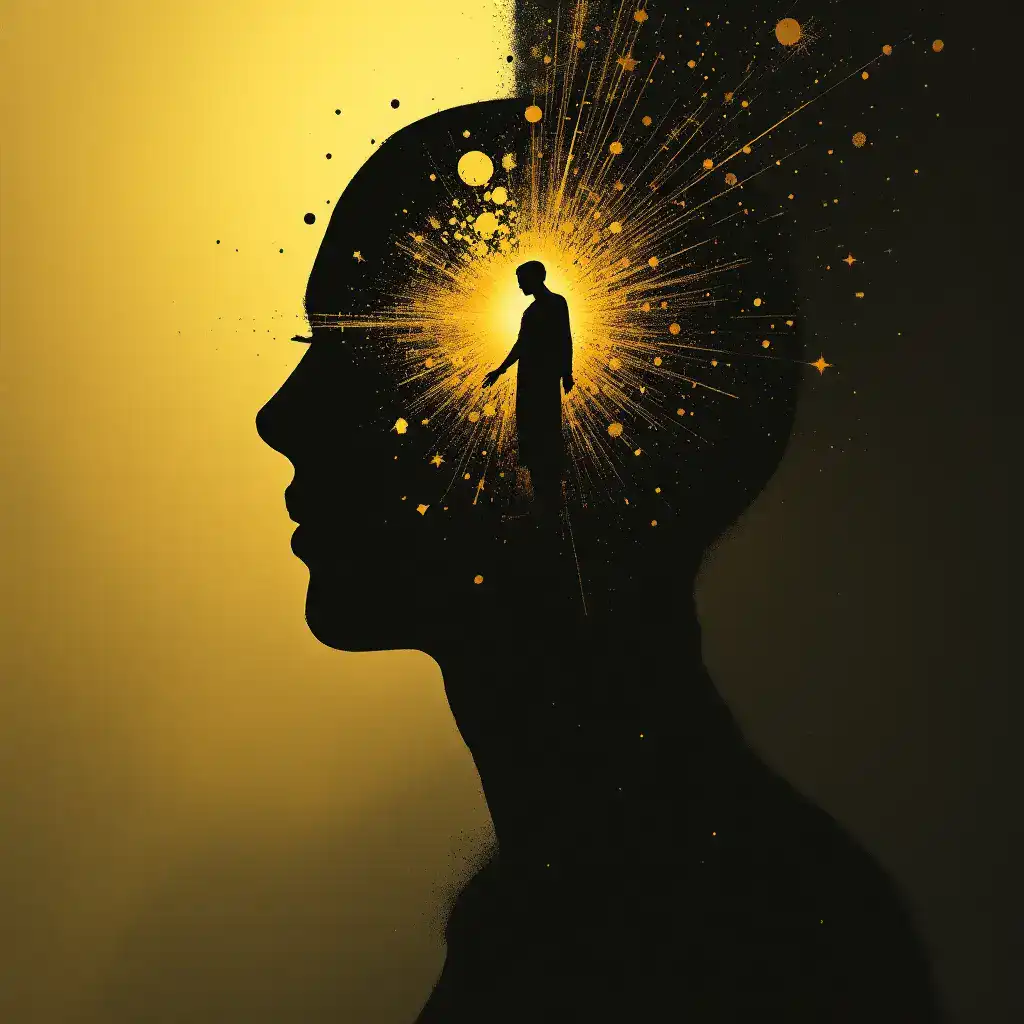
The difference between ego and self is not a semantic debate. It is the line between sovereignty and enslavement. Most people live their entire lives believing the ego is who they are, never realizing it is simply the operating system, not the operator. The ego defends, reacts, and clings. The self observes, integrates, and transcends. Understanding this difference is the foundation of all inner mastery.
The ego is not your enemy. It is a necessary instrument for navigating the physical world. It gives you a sense of individual identity, protects you from perceived threats, and helps you make decisions quickly. But when the ego believes it is the driver rather than the vehicle, it takes control of your entire life. Every reaction, every defense, every craving becomes a command you obey without question. The self, by contrast, is the awareness that witnesses the ego. It is the steady center that remains when every external label falls away.
What the Ego Actually Is
The ego is a construct built from experience, conditioning, and survival programming. It is the accumulated beliefs about who you are based on your name, your roles, your achievements, and your wounds. The ego forms early in life as a necessary adaptation. A child learns what behaviors earn approval and what actions bring punishment. Over time, these learned patterns crystallize into identity. The ego says: I am a teacher, I am successful, I am broken, I am unworthy. Each statement is a boundary the ego draws to define itself against the world.
From a biological perspective, the ego operates primarily through the default mode network, a brain system that activates when you are not focused on external tasks. This network generates self-referential thought, the constant inner narration about who you are, what you want, and what threatens you. It is the voice that says I need this, I fear that, I deserve more. The ego is not a single structure but a pattern of neural activity that reinforces a sense of separate self.
The ego’s primary function is survival. It scans for threats, categorizes experiences as safe or dangerous, and builds strategies to avoid pain and pursue pleasure. This was useful when survival required constant vigilance. In the modern world, where physical threats are rare, the ego has expanded its territory. It now treats social rejection, criticism, and uncertainty as existential dangers. The nervous system cannot tell the difference between a predator and a harsh email. Both trigger the same defensive cascade. The ego responds by tightening, defending, and reinforcing the walls of identity.
What the Self Actually Is
The self is not a thing you build. It is what remains when all constructed identities dissolve. The self is pure awareness, the consciousness that observes thought, emotion, and sensation without being defined by any of them. You are not your thoughts. You are the space in which thoughts arise. You are not your emotions. You are the presence that feels them move through you. The self is the eternal I am, the unchanging witness that has been present since your first breath and will remain until your last.
Every mystical tradition points toward this same distinction. The Hindus called it Atman, the true self that is identical with Brahman, the universal consciousness. The Buddhists described it as the awareness that remains when the illusion of a separate self is seen through. The Stoics taught that your essence is not your body, your reputation, or your possessions, but the rational soul that observes and chooses. The difference between ego and self is the difference between the wave and the ocean. The wave believes it is separate, distinct, fighting for survival. The ocean knows every wave is itself.
The self does not react. It responds. When the ego is triggered, it defends immediately, often before conscious thought can intervene. The self pauses. It witnesses the trigger, recognizes the pattern, and chooses a response aligned with coherence rather than fear. This is not suppression. It is mastery. The self does not deny emotion. It allows emotion to move through without being controlled by it. This capacity to observe without identification is what transforms a reactive life into a sovereign one.
Why Most People Live From Ego
The reason most people never discover the self is simple: the ego is loud, and the self is quiet. The ego demands attention. It narrates constantly, generating stories about the past and rehearsing fears about the future. The self speaks in silence, in the gaps between thoughts, in the stillness that arises when the mind finally stops defending. The modern world is designed to keep the ego engaged. Constant stimulation, endless notifications, and manufactured urgency ensure the nervous system never settles long enough for the self to emerge.
The control systems explored throughout the Master Thyself framework understand this distinction perfectly. A population locked in ego identification is predictable, manageable, and profitable. Ego-driven people chase external validation, consume compulsively, and react to manufactured threats. They do not question the system because they are too busy defending the self-image the system sold them. The ego is not the enemy, but an unexamined ego is the easiest point of control. When you believe you are your job title, your bank account, your social media presence, you become dependent on the structures that validate those identities. Lose the job, the status, or the approval, and the ego collapses. That collapse feels like death because the ego genuinely believes it is you.
This is why awakening often begins with crisis. A loss, a betrayal, a moment when every external support falls away, and the ego has nothing left to cling to. In that void, the self can finally be felt. Not as an idea, but as a presence. The awareness that has been watching the entire time, steady and unbroken, waiting for the noise to quiet.
The Biological Mechanism Behind Ego Dissolution
Neuroscience has begun mapping what the mystics described for millennia. When the default mode network quiets, either through meditation, breathwork, fasting, or other practices, the sense of a separate self dissolves. Brain imaging studies show that experienced meditators exhibit reduced activity in the regions associated with self-referential thought. The boundary between self and other softens. The constant inner narration fades. What remains is awareness without a narrator.
This is not a malfunction. It is the brain returning to a more fundamental operating mode. The practices that quiet the ego do not destroy anything essential. They remove the static so the signal can be heard. The ego does not disappear. It becomes transparent. You still have preferences, make decisions, and navigate relationships. But you are no longer enslaved by the need to defend, prove, or inflate the constructed self. The ego becomes a tool you use rather than a master you serve.
The mechanism is physiological. When the nervous system registers safety, when cortisol drops and the vagus nerve activates, the body stops running threat assessment. The mind stops generating defensive narratives. In that state, the self is not something you achieve. It is what you are when fear finally stops talking. Chapter 22 of Master Thyself details the exact timing, rhythm, and protocol required to stabilize this state, but the principle is universal: coherence allows the self to emerge. Fragmentation keeps the ego in command.
The Ego as Driver Versus Ego as Passenger
Ego death is not the annihilation of the ego. It is the demotion of the ego from a role it was never designed to hold. The ego was meant to be the instrument, not the conductor. When the self takes the wheel, the ego is finally free to do what it does best: experience life fully, without the burden of controlling it. This is the real resurrection described in every tradition. Not the elimination of the personal self, but its integration into something larger.
Think of the difference between ego and self as the difference between a security guard and the building owner. The security guard scans for threats, checks credentials, and decides who gets in. That function is necessary. But when the security guard believes he owns the building, he begins making decisions beyond his authority. He locks doors that should stay open, bars people who belong, and exhausts himself defending a property that was never his. The building owner, by contrast, sees the whole structure. The owner knows when to trust the guard and when to override him. The owner can open every door because the owner is not afraid of what might enter. That is the self. The ego is the guard. Both are needed. Only one should be in charge.
How to Recognize When Ego is Driving
You know the ego is in control when reaction is faster than awareness. When criticism lands and your body tightens before you have consciously registered the words. When you defend a position not because it is true but because admitting you were wrong feels like death. When you need to be right, to be seen, to be validated, the ego is steering. The self does not need these things. The self can hold uncertainty, sit with discomfort, and change direction without collapse.
Another sign: attachment to outcomes. The ego plans, manipulates, and forces. It believes it must control every variable to stay safe. The self sets intention and releases the how. It trusts that coherence will guide the path. When you find yourself white-knuckling a relationship, a project, or a belief system, the ego is driving. When you can hold something lightly, appreciating it without clinging, the self is present.
Comparison is always ego. The self has no need to measure itself against others because it does not derive worth from external markers. Envy, superiority, insecurity, all ego signals. The self sees others clearly, without the distortion of competition or judgment. When you notice yourself scanning a room to see who is more successful, more attractive, more accomplished, the ego is running the show. When you can witness another person’s gifts without feeling diminished, the self is awake.
The Practices That Reveal the Self
The self is not something you create. It is something you uncover. Every practice that quiets the ego allows the self to emerge. Meditation is the most direct route. Sitting in stillness, watching thoughts arise and pass without attaching to them, trains the nervous system to recognize the difference between awareness and content. You are not the thought. You are the one noticing the thought. That recognition is the beginning of sovereignty.
Fasting removes the static of appetite and survival signaling. When the body is not constantly digesting, defending, or craving, the mind settles. The ego, which thrives on urgency, has less to react to. In that quiet, the self becomes obvious. Breathwork shifts the nervous system out of fight or flight and into a state where the default mode network can finally rest. The protocol detailed in the complete framework synchronizes these elements into a system that does not require belief, only consistent application.
Service is another doorway. When you act on behalf of something larger than personal gain, the ego’s grip loosens. The self does not need credit. It does not need recognition. It acts because action is aligned, not because action will be rewarded. This is why so many traditions emphasize selfless service as a path to awakening. It trains the ego to step aside.
Living From the Self in a World Built for Ego
Once the difference between ego and self is felt, not just understood intellectually, the real work begins. The world will still trigger the ego. Traffic, conflict, criticism, loss, all of it will still arrive. The difference is speed of recovery. The awakened person still feels the trigger. The nervous system still responds. But the return to center happens faster. The emotional wave moves through without creating a story that lasts for days.
This is what Chapter 23 describes as the real exam. Awakening in a cave is one thing. Awakening in a checkout line when the person ahead is moving slowly and you are already late is another. The self does not need perfect conditions. It remains steady regardless of circumstance. The ego needs control, certainty, and comfort. The self needs none of these. It is already whole.
Living from the self does not mean you stop having preferences or setting boundaries. It means those preferences and boundaries arise from clarity rather than fear. You can say no without guilt. You can walk away from what does not serve you without needing to justify the choice. You can love deeply without clinging. This is the freedom every tradition points toward. Not the elimination of the personal experience, but the liberation of it.
The Ego Will Return, and That Is Fine
Ego dissolution is not a one-time event. It is a practice. The ego will reassert itself. Old patterns will resurface, especially under stress. The difference is that you now recognize them. You see the ego rising, and instead of being swept into its narrative, you pause. You breathe. You choose. That pause is mastery. Not perfection. Not the permanent elimination of reactivity. Just the gap between stimulus and response, long enough for the self to choose the next move.
The trap is expecting enlightenment to mean the ego never speaks again. It will. The voice will suggest you are not enough, that you need to prove yourself, that you are under threat. The self hears that voice and knows it is not the truth. The self does not fight the ego. It simply does not obey it. Over time, the ego becomes quieter, not because it has been destroyed, but because it has been seen. And what is seen clearly loses its power to control.
Why This Distinction Changes Everything
Understanding the difference between ego and self is not an intellectual exercise. It is the mechanism of liberation. When you know you are not your thoughts, your past, your roles, or your wounds, you become unmanageable by any system that profits from your identification with those things. You cannot be sold an identity if you know identity is a construct. You cannot be controlled by fear if you know the awareness you are cannot be harmed. You cannot be fragmented if you recognize the self as already whole.
This is the teaching encoded in every scripture, every mystery school, every tradition that survived long enough to pass the signal forward. The language changes. The geography changes. The rituals change. But the core instruction is always the same: you are not the wave. You are the ocean. The ego is the wave, necessary, beautiful, temporary. The self is the ocean, eternal, unchanging, vast enough to hold every wave without being defined by any of them.
When you live from the self, the world does not change. You change. And when enough people make that shift, the field itself begins to reorganize. Not through force, but through coherence radiating outward, one nervous system at a time, until the tipping point arrives and the whole system remembers what it always was.