
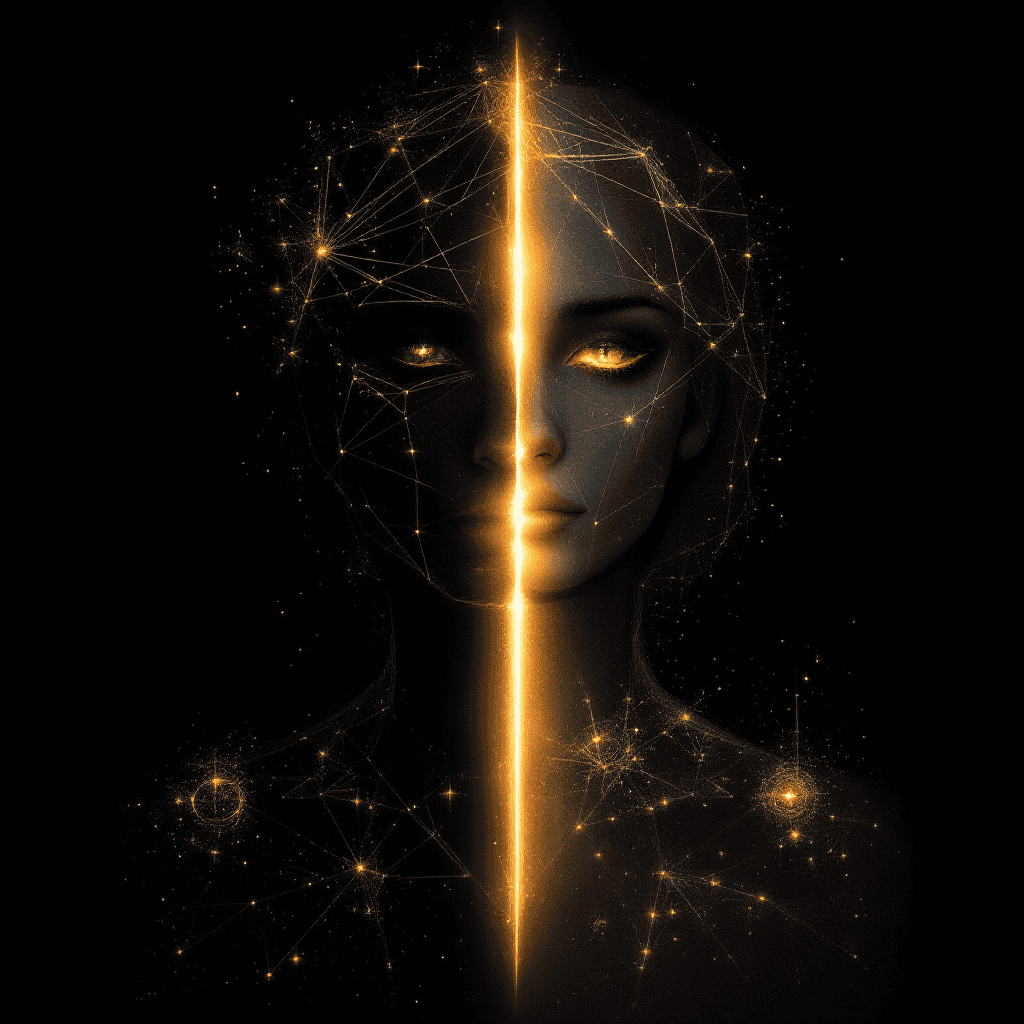
The difference between ego and self is the foundation of every spiritual practice, every authentic awakening, and every journey toward sovereignty. Most people spend their entire lives operating from ego, convinced it is who they are, never realizing that beneath the noise, the reactive patterns, and the endless commentary sits something quieter, deeper, and far more real. The ego is not evil. It is not your enemy. But it is not you. Understanding this distinction changes everything.
What the Ego Actually Is
The ego is the constructed identity your mind built to navigate the world. It is the story you tell yourself about who you are, assembled from memory, social conditioning, trauma, success, failure, and comparison. It is the voice that narrates your experience, judges your choices, defends your position, and keeps score. It is the part of you that says I am smart, I am broken, I am better than them, I am not enough. The ego is not inherently bad. It serves a function. In a dense, polarized reality, it helps you make decisions, establish boundaries, and move through the world without dissolving into chaos.
But here is what the ego is not: it is not the totality of your being. It is a tool, not the operator. A suit you wear, not the body underneath. The problem begins when the tool starts running the show. When the ego believes it is in charge, it operates from survival, scarcity, and separation. It sees threats everywhere because its job is to protect the constructed self. It clings to identity because without that identity, it fears it will cease to exist. And in a way, it is right. The ego cannot survive the dissolution of its boundaries. That is why it resists awakening so fiercely.
The ego lives in the solar plexus, the seat of personal power and reactive will. It anchors you to the frequency of control, competition, and comparison. Freudian psychology mapped the ego as the mediator between the unconscious id and the moral superego, but the mystery traditions understood it more precisely as the fragment that forgot it was whole. The ego is the point of maximum contraction, the singularity that pulled inward rather than expanding outward like the Flower of Life.
What the Self Actually Is
The Self is not constructed. It is eternal. It is the consciousness that observes the ego, the awareness that remains when all identity dissolves. The Self does not narrate. It witnesses. It does not defend. It accepts. It does not fear death because it knows it cannot die. The Self is not the thoughts you have. It is the one watching the thoughts arise. It is not the emotions that flood you. It is the space in which those emotions move. The Self is the I Am beneath every constructed I am this or I am that.
Carl Jung called it the Higher Self, the integrated totality of conscious and unconscious that emerges when the ego finally surrenders its grip. The Vedic traditions called it Atman, the eternal essence identical to Brahman, the unified field. Christianity encoded it in the teaching that the kingdom of God is within you. Not somewhere else. Not after death. Within. Right now. Hidden beneath the noise of egoic chatter. The Self is what remains when fasting quiets appetite, when meditation stills the mind, when breathwork regulates the nervous system, and when coherence stabilizes the heart.
The Self does not live in one location. It is the field that coordinates the whole. When the lower centers are purified and the heart opens, the Self can finally express through the vessel without distortion. This is what the ancients called righteousness, not moral superiority but internal coherence, a clear channel through which the divine current flows unimpeded.
Why the Difference Between Ego and Self Matters
Understanding the difference between ego and self is not an intellectual exercise. It is the difference between being a passenger in your own life and taking the controller. The ego operates reactively. It sees the world through a lens of threat and opportunity, scanning for validation and defending against perceived attack. It interprets every event personally. Someone cuts you off in traffic, and the ego makes it about you. Someone disagrees, and the ego experiences it as assault. The ego cannot rest because it cannot trust that it is safe unless it stays vigilant, scanning, judging, controlling.
The Self operates from presence. It sees clearly without distortion. It responds rather than reacts. It holds space for paradox, for uncertainty, for the full spectrum of human experience without collapsing into identification with any single pole. The Self does not need to be right. It does not need to win. It does not need external validation because it knows what it is. This is the frequency that changes everything. This is what the Master Thyself framework points toward: sovereignty through inner alignment, coherence through the dissolution of false identity.
When you operate from ego, you are running code written by someone else. The Architects of Control understand this perfectly. They do not need to chain you. They only need to keep the ego activated, keep the survival program running, keep you fragmented enough that you never access the Self. Processed food suppresses pineal function. Engineered news cycles keep cortisol elevated. Social division prevents coherent community. Screen overstimulation blocks the theta states where the Self can finally speak. Every tool of modern distraction is designed to keep the ego in command and the Self buried.
The Ego in Spiritual Bypassing
One of the ego’s most sophisticated tricks is spiritual bypassing, the process of using spiritual concepts to avoid uncomfortable emotions, unresolved trauma, or necessary inner work. The ego hears about surrender and decides it means never setting boundaries. It hears about oneness and uses it to justify staying in toxic relationships. It hears about non-attachment and abandons responsibility. This is the ego wearing the costume of the Self, performing awakening while maintaining control.
True surrender is not passivity. It is alignment. True non-attachment is not indifference. It is freedom. The Self does not need to perform spirituality because it is not performing anything. It simply is. The ego, by contrast, collects experiences, teachers, retreats, and insights like trophies, building a spiritual resume while the core wound remains untouched. The difference between ego-driven practice and Self-led practice is the difference between chasing the high and stabilizing the frequency.
Awakening is not the end of the ego. It is the end of the ego’s misassignment. The ego was never supposed to drive. It was never built for that job. When the Self takes the wheel, the ego is finally free to do what it was actually built for: not to control experience, not to manufacture it or protect itself from it, but to be present inside it. The person in coherence still wants things, still enjoys beauty, pleasure, connection, and desire. What disappears is the desperation. The ego flourishes. It just stops driving.
How to Recognize Which One Is Operating
There is a simple test. When a decision or reaction arises, ask: is this coming from fear or from presence? The ego operates from fear, even when it looks like confidence. It needs to be seen, to be right, to maintain the constructed self. The Self operates from stillness. It does not need to prove anything. The ego speaks in absolutes: I am always this way, they are wrong, this must happen now. The Self speaks in awareness: this is what I notice, this is what arises, this is one way forward.
The ego resists uncertainty. The Self rests in it. The ego collapses under pressure. The Self remains steady. The ego fragments when challenged. The Self integrates. If you feel tightness, defensiveness, or the compulsion to explain yourself, that is ego. If you feel spaciousness, curiosity, or the ability to hold paradox without needing resolution, that is Self. Neither is permanent. You will move between them many times in a single day. Mastery is not the elimination of ego. It is the recognition of which one is active and the ability to return to Self when the ego has taken over.
The practices that restore this recognition are ancient and precise. Fasting quiets the egoic demand for constant consumption and stimulation. Meditation trains the mind to observe rather than identify. Breathwork regulates the nervous system so the body stops signaling threat. Heart coherence practices stabilize the electromagnetic field so the Self can broadcast without interference. These are not metaphors. They are biological technologies rooted in the body’s own design, mapped by the ancients and confirmed by modern research.
Ego Death and the Narrow Gate
Every authentic spiritual tradition describes a threshold where the ego must be surrendered before the Self can fully emerge. Christianity called it being born again. Mystery schools called it initiation. The mystics called it the dark night of the soul. Psychedelics and plant medicine cultures call it ego death. The language changes. The mechanism does not. The ego, built on separation and control, cannot pass through the gate. It is too dense, too defended, too identified with form. The narrow gate Christ described was not a moral test. It was a physics problem.
Ego death is not the destruction of the personality. It is the dissolution of the belief that the personality is all you are. The constructed self, the story you have been telling yourself for decades, finally cracks open. What emerges is not nothing. It is everything. The Self that was always there, quiet and eternal, waiting beneath the noise. This is why the three day fast has been preserved across every tradition. Day one, the ego protests. Day two, autophagy peaks and the old proteins begin to break down. Day three, renewal begins. The body rehearses resurrection. The ego dies symbolically so the Self can rise.
But ego death is not a one time event. It is a practice. Every time you choose presence over reaction, every time you release the need to be right, every time you witness your thoughts without becoming them, you are rehearsing the same dissolution. The gate opens not once but in every moment you choose the Self over the ego. The full protocol for ego dissolution and Self stabilization is detailed in Chapter 22 of Master Thyself, where the physiological mechanics of the narrow gate are mapped with precision. The chapter reveals REDACTED, READ CHAPTER 22, the exact sequence the body requires to stabilize the Self after the ego releases its grip.
Living From the Self in Daily Life
The real test of mastery is not the meditation cushion. It is Tuesday afternoon. The loud neighbor. The inconsiderate driver. The colleague who takes credit for your work. These are not interruptions to your practice. They are your practice. Every ordinary friction is a live exam, a chance to see whether the ego or the Self is running the show. When someone cuts you off in traffic, does the ego flare and make it personal, or does the Self observe the reaction and let it pass? When criticism lands, does the ego defend and counter, or does the Self listen without attachment?
Living from the Self does not mean you never feel anger, fear, or grief. It means those emotions move through you without hijacking the whole system. The Self holds space for the full range of human experience without collapsing into identification with any single state. This is the balance the ancients pointed toward. Not the elimination of polarity but the ability to stand steady within it. The interplay of opposites does not vanish after awakening. It intensifies because you see it more clearly. Mastery is the ability to remain centered while the storm unfolds.
The Self does not perform. It does not need to announce its presence or convince anyone of its authenticity. It simply is. When the Self stabilizes, your outer world begins to reflect it. Relationships that once drained you dissolve. Opportunities that match your frequency appear without force. The field responds not to what you want but to what you are. This is why coherence matters more than intention. A noisy signal, no matter how sincere, scatters. A clean signal, held in stillness, organizes probability around it.
The Ego as Teacher
Here is the paradox: the ego is not the enemy. It is the curriculum. Every time it flares, it shows you where you are still identified, still contracted, still operating from fear. The goal is not to destroy the ego but to recognize it, thank it for trying to keep you safe, and gently return to the Self. The ego dissolves not through force but through sustained presence. The more you rest in the Self, the less the ego needs to fight for control.
This is why spiritual traditions emphasize daily practice. Not because a single session of meditation or prayer will fix everything, but because every return to presence weakens the ego’s grip and strengthens the Self’s signal. Over time, the baseline shifts. What once required effort becomes automatic. The Self becomes the default operating system rather than the exception. This is the stabilization Chapter 23 describes: not the peak experience but the plateau, the quiet strength of coherence that endures through ordinary life.
The difference between ego and self is not an abstract teaching. It is the most practical distinction you will ever make. It determines whether you live reactively or consciously, whether you are ruled by fear or guided by presence, whether you remain a passenger in the simulation or take the controller. The ego will never stop trying to reassert itself. That is its nature. But the Self, once recognized, cannot be unseen. And every time you return to it, you are casting a vote for a different kind of life.
The Anchor Practice
When the ego takes over and you need to return to the Self, use the anchor. Place one hand on your heart and one on your abdomen. Breathe in for five seconds, out for five seconds. Do this for two minutes. The rhythm entrains the nervous system. The touch grounds awareness in the body. The breath signals safety. This is not theory. This is the biological reset the ancients encoded in every contemplative tradition. REDACTED, READ CHAPTER 22 to amplify the anchor when the ego is particularly loud.
The second anchor is language. When the ego begins its commentary, name it. That is ego. Not as judgment but as recognition. The act of naming creates distance. You are not the thought. You are the one observing the thought. This is the shift from identification to awareness, from passenger to operator. Every time you name the ego, you are choosing the Self. Every time you choose the Self, the path becomes a little clearer.
The Silver Cord and the Self
The traditions teach that a silver cord tethers the soul to the body, anchored at the solar plexus, the exact location where the ego resides. This is not coincidence. The cord holds you to the frequency you operate from most often. An unawakened soul, living entirely from ego, is anchored to the reactive self, the frequency of collapse. A soul that has moved its center of gravity to the Self is anchored higher. The cord does not trap the soul that has already shifted its baseline. It simply releases from a different level.
This is why the work matters beyond this lifetime. What you stabilize here, you carry to the threshold. The coherence you build is not performance. It is structural integrity. When the body ends and the cord releases, the Self that has been cultivated through sustained practice does not fragment. It endures. The ego, by contrast, cannot survive the transition. It was always temporary. The Self is eternal. Knowing the difference is not just the foundation of awakening. It is the foundation of what continues after the body is gone.
The Final Recognition
The difference between ego and self is the difference between the wave and the ocean. The wave believes it is separate, distinct, moving on its own. The ocean knows every wave is itself, temporary expressions of a single body of water. The ego is the wave insisting on its individuality. The Self is the recognition that you were always the ocean. The mystery schools preserved this truth through initiation. The mystics lived it through direct experience. The scriptures encoded it in plain language for anyone willing to look.
You are not your thoughts. You are not your history. You are not your achievements or your failures. You are not the story the ego built to navigate a polarized world. You are the consciousness that observes all of it, the eternal I Am that remains when every constructed identity dissolves. Mastering the difference is not the end of the journey. It is the beginning. From this foundation, everything else becomes possible. Ego dissolution and sovereignty are not destinations. They are directions. And every step you take from the Self rather than the ego writes a different story into the field.
The teaching is complete. The practice is yours.